Traumreise
AI-designed, agent-built personalized bedtime story app
A touch-first, bilingual app that turns a child’s real day into a calming, narrated bedtime story—built as an experiment in AI-driven design and agentic development.

Traumreise began with a very human problem: bedtime. Many parents experience the same situation every evening—children are tired, the day was long, and yet falling asleep becomes a challenge. Reading stories often helps, but it requires time, creativity, and emotional energy that are not always available. Traumreise was conceived as a way to ease that moment by turning a child’s real day into a calming, personalized bedtime story—generated and narrated automatically.
Very early on, however, the project evolved into something larger. Traumreise is not only a product idea; it is also a deliberate experiment in AI-driven design and agentic software development. The central question became: How much of a modern digital product can be designed and built by AI, if a human provides direction, constraints, and judgment instead of writing every line of code or designing every screen manually?
Application Idea and Vision
At its core, Traumreise is a personalized bedtime story application for children aged roughly two to eight. Parents create a profile for each child, including name, age, and interests such as animals, vehicles, or favorite colors. Each evening, they add a few short notes about the day—events like a birthday party, a visit to the park, or time spent with grandparents. From this minimal input, an AI model generates a calm, age-appropriate story in which the child is the main character. The story is then converted into narrated audio and played directly in the app.
The vision is intentionally modest and focused. Traumreise is not meant to maximize screen time or stimulation. Instead, it aims to become part of an evening ritual—predictable, gentle, and emotionally grounding. The personalization is the key: when children hear their own name and recognize moments from their real day, the story feels familiar and reassuring, which supports relaxation rather than excitement.
An Experiment in AI-Driven Design
From the outset, Traumreise was also designed as a meta-experiment. Almost all conceptual work—product definition, user flows, UX principles, monetization strategy, and cost modeling—was developed collaboratively with AI systems. Under my guidance, AI was used not only to refine ideas, but to structure them into coherent design documents and architectural decisions.
Every major design artifact was produced this way: onboarding flows, accessibility requirements, bilingual content strategy, touch-first interaction rules, and even detailed UI behavior such as loading states and error handling. My role throughout the process was not to “ask for output,” but to continuously constrain, challenge, and redirect the AI—much like a creative director or system architect would guide a team.
This approach deliberately shifted effort away from manual execution and toward decision-making, prioritization, and evaluation. The result is not an AI-generated prototype, but a thoughtfully structured product whose design rationale can be traced back to explicit constraints and goals.
Technology Stack and Architecture
The technical architecture reflects the same philosophy: modern, modular, and scalable, without unnecessary complexity. The backend runs on Google Cloud Run using FastAPI, embracing a serverless-first model that scales automatically and keeps operational overhead low. Authentication is handled entirely through Firebase Authentication, avoiding the need for a custom user database. Firestore serves as the primary data store for user profiles, children’s data, and story metadata, while generated audio files are stored in Google Cloud Storage and accessed via signed URLs with lifecycle rules for automatic cleanup.
AI integration is split into two clear responsibilities. Story generation is handled by a lightweight GPT model optimized for cost and latency, while narration is produced using Google Cloud Text-to-Speech to ensure consistent, high-quality audio in both German and English. The system supports streaming and chunked processing so that perceived waiting times are minimized and feedback remains responsive.
On the frontend, the application is built with React and Vite, using Tailwind and a shared component library to ensure visual consistency. Animations and transitions are implemented with Framer Motion, not for spectacle, but to create a calm, reassuring experience that fits the bedtime context. Internationalization is treated as a first-class concern, with all text content centralized and easily extendable to additional languages.
Crucially, the entire codebase—frontend, backend, infrastructure, and CI/CD—was generated by agentic coding AI, primarily using Visual Studio Code with the Cline extension and Claude Sonnet as the coding model. The AI created project structures, API endpoints, UI components, infrastructure definitions, and deployment pipelines. My contribution focused on reviewing, correcting, and refining the output, ensuring architectural consistency, security, and maintainability.
UX, Visual Design, and Interaction Principles
The user experience was shaped around a few strict principles that were repeatedly reinforced during AI-assisted design iterations. All interactions are touch-first, with large targets that children can tap confidently. All flows are wizard-based, presenting only one decision per screen to reduce cognitive load. Visual design emphasizes softness and calmness through color, spacing, and motion, avoiding anything that feels rushed or overly technical.
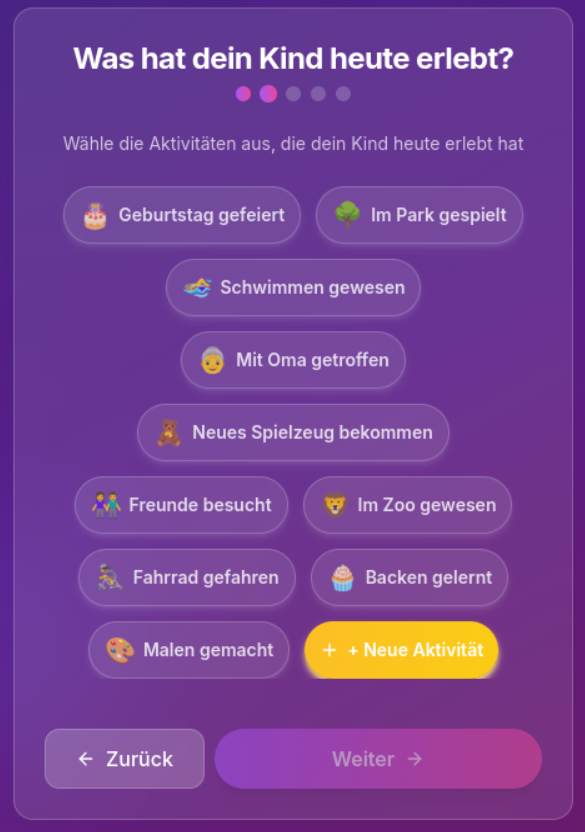
One notable example is the activity selection interface used when entering daily events. Instead of traditional lists or checkboxes, the app uses large, emoji-enhanced chips that can be selected or deselected with a tap. Suggested activities are presented visually, while custom entries can be added instantly and then reused in the future. This interaction pattern feels playful without being chaotic and works well for both adults and older children.
The bilingual nature of the app is fully integrated into the UX rather than layered on top. All copy, labels, suggestions, and messages are managed centrally, and language selection persists across sessions. This makes the system consistent, maintainable, and ready for expansion.
Marketing and Growth Considerations
The marketing strategy follows directly from the product’s emotional value. Parents searching for bedtime solutions represent high-intent traffic, making search ads particularly effective. Social platforms such as Instagram and Facebook are well suited for discovery, as short videos can easily demonstrate the transformation from a few bullet points into a complete bedtime story. Influencer partnerships with family-focused creators help establish trust, while app store optimization supports organic growth over time.
Importantly, the technical architecture supports these efforts by enabling analytics, A/B testing, and feature gating without major refactoring—another outcome of designing the system holistically from the start.
Business Case and Viability
Traumreise follows a freemium model with a deliberately generous free tier of three stories per week. This allows users to experience the real value of personalization while keeping costs predictable. Paid subscriptions unlock higher limits, additional voices, and deeper customization options, while a credit-based model supports occasional users.
Because the system is serverless and usage-based, fixed costs remain low. Even with around one thousand active users on the free tier, monthly operating costs remain modest, dominated primarily by AI story generation and text-to-speech. This creates a favorable foundation for scaling once paid conversions begin.
Agentic AI as a Development Paradigm
Perhaps the most important outcome of this project is not the app itself, but the workflow it demonstrates. Traumreise shows that agentic AI can meaningfully participate in the full lifecycle of a product, from ideation and design through implementation and deployment—provided that a human supplies clear intent, constraints, and critical judgment.
In this model, the role of the developer or designer shifts away from manual execution and toward orchestration, evaluation, and direction. AI becomes neither a replacement nor a simple tool, but a capable collaborator operating within well-defined boundaries.
Traumreise is both a functioning application and a proof of concept for this way of working. It represents my exploration of how AI-augmented design and development may shape the future of software creation—less about writing code line by line, and more about shaping systems with clarity, empathy, and intent.
Screenshots
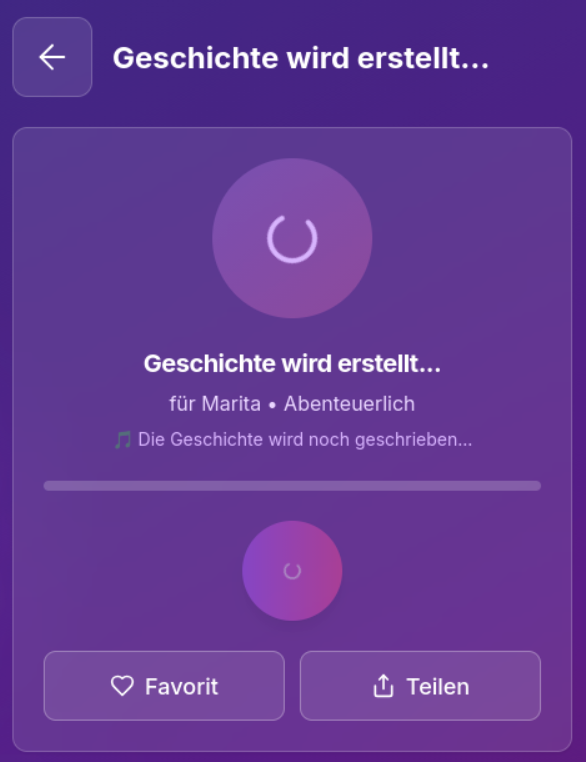
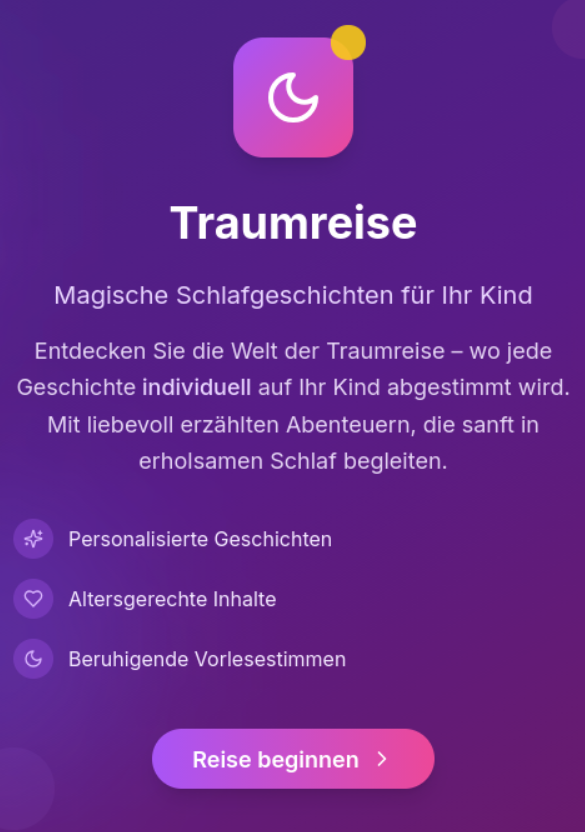
Landing / Story view
Activity selection
Audio player